They're already using AI. This is the one that makes them think.
theoremEd reads the problem on their screen, finds the exact step they got wrong, and asks them one question about it. It will tell them when an answer is right. It will never tell them what it is — not when they insist, and not when they're out of time.
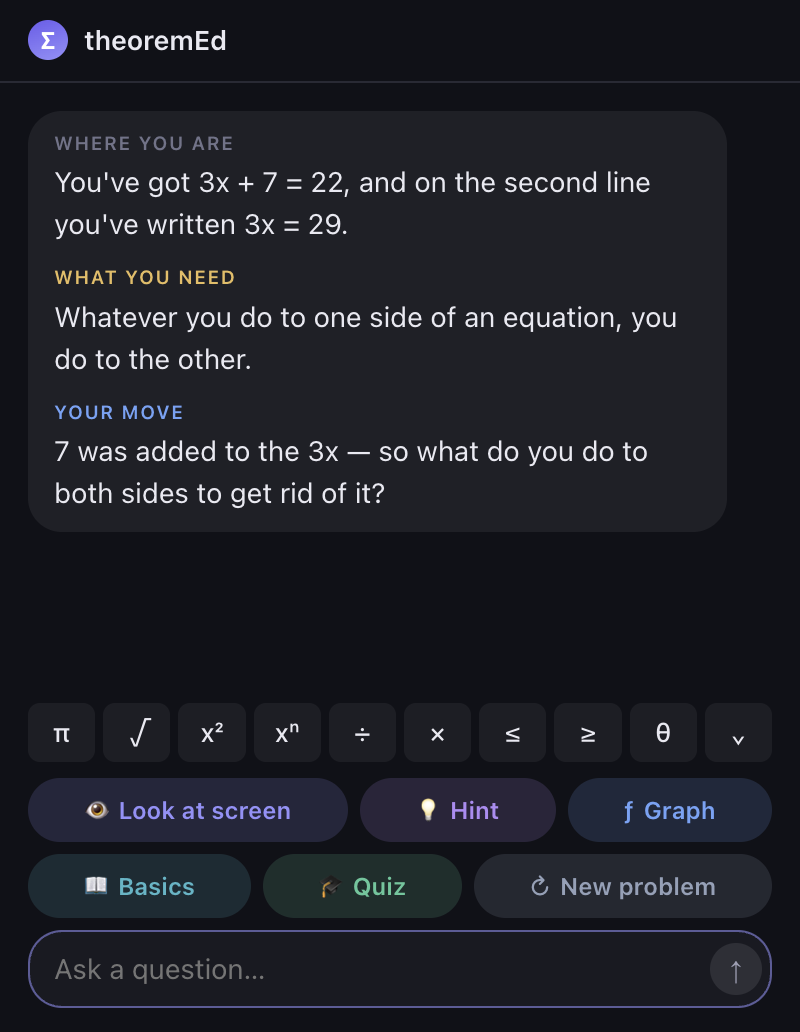
The actual problem
The question was never whether they'd use AI.
Your child can have any homework question answered in four seconds, and so can everyone in their class. That isn't a problem arriving later, and no filter, no honour code and no app blocker is putting it back in the box.
So the question worth asking is a different one: what does it do when they open it? Most of them hand over the answer, the homework gets handed in, and the gap only shows up on the test — by which point a term has gone.
theoremEd is the same technology, built to refuse. It finds where they got lost and then stops. That is the entire product, and there is no setting that turns it off.
A tutor who does the work for you is a tutor who guarantees you'll be stuck again tomorrow.
What it refuses to do
It will not state the answer, carry out the next step, or hand over the same problem worked through with different numbers. It holds that line when a student insists, claims to be out of time, says their teacher allows it, or says it already told them. There is no setting that turns it off, because a switch like that is the only feature that would ever get used.
It will tell them whether an answer they worked out themselves is right or wrong. Marking work isn't doing it.
It teaches, then gets out of the way
Explanations name the rule as they use it, and it stops explaining the moment a student shows they already know something.
It notices what they've mastered
Once they've solved a kind of problem unaided, it points them back at their own earlier success instead of teaching it again.
It won't let them feel stupid
No "just", no "simply", no "as you know". Those words are how a struggling student decides to stop asking.
You can see what they worked on
It keeps a record of the problems and the sticking points, and builds practice sheets from their real weak spots.
What it costs
A private math tutor runs $40–$100 an hour, once or twice a week, and is not there at 10pm on a Tuesday when the problem set is due. theoremEd is there every night for less than a single session.
Free
$0forever · not open yet
No card and no account. Let them try it tonight.
- 25 questions to start, then 5 a week
Basic
$19.99a month · not open yet
Roughly a problem set a night, every school night.
- 150 questions a month
- Graphing, quizzes, practice sheets
Plus
$29.99a month · not open yet
For two hard classes at once.
- 400 questions a month
Cancel whenever. The free tier doesn't expire, so nothing lapses into a charge you didn't mean to make.
The questions parents actually ask
What can it see on my child's computer?
The single tab or window they point it at, at the moment they press the button. Nothing else, and nothing when they're not asking. It does not read browsing history, does not run in the background, and carries no advertising. Screenshots go to theoremEd's server, are passed to Anthropic's API to produce the reply, and are not stored. The privacy policy is in plain English.
Does it collect personal information?
No. There is no account, no sign-in, and it never asks for a name, an email or an age. The only thing stored on our side is a count of questions asked, so limits can be enforced.
Couldn't they just use a chatbot instead?
They could, and it would hand them the answer, which is the problem. theoremEd is built the other way round: the refusal is the product. It also reads the actual problem on screen, so there's no retyping and no chance of them describing it wrongly.
Will their teacher have a problem with it?
Show them this page. A tool that refuses to give answers and points students at the concept they're missing is the thing teachers ask for. We'd rather the conversation happened up front.
My child uses a school Chromebook.
Then use the Chrome version. It installs from the Chrome Web Store and works on any Chromebook. Some school-managed devices restrict extensions — if yours does, your IT administrator has to allow it.
Who's behind it?
Andrew Farca, a high school student, who built it because the choice on offer was to stare at a problem for an hour or copy an answer he didn't understand. You can reach him at hello@theoremed.com.